
Swirl Marks vs Scratches on Car Paint: The Clear Coat Restoration Guide
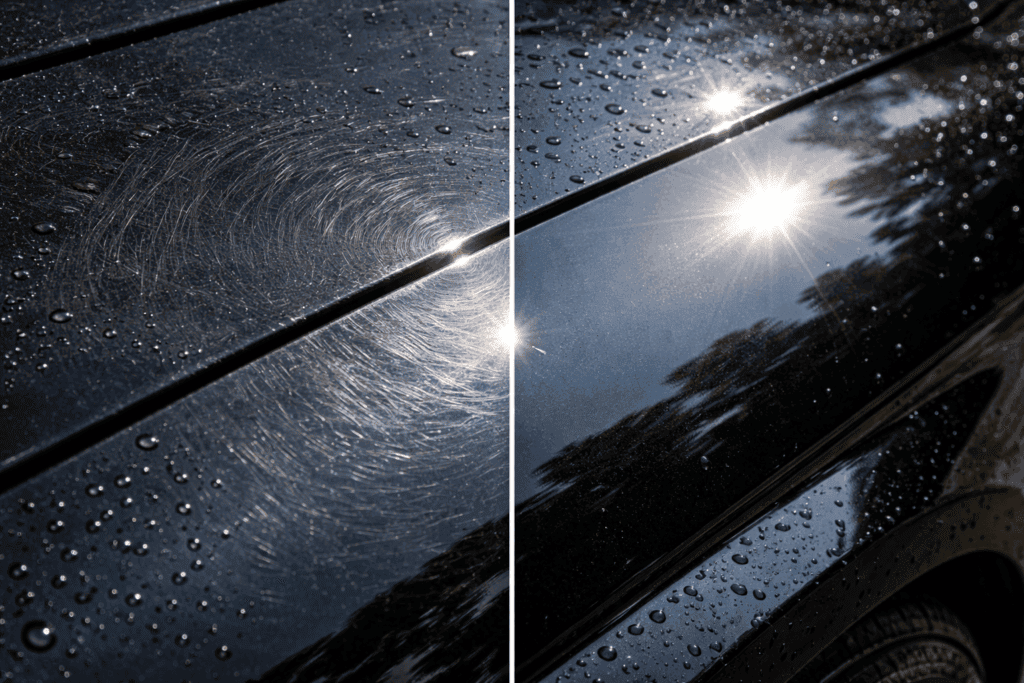
Walking out to your vehicle on a bright, sunny afternoon often reveals an unwelcome surprise across the hood, doors, and fenders. Instead of a crisp, deep reflection, the clear coat displays a hazy web of spiderweb-like halos or sharp, isolated white lines. Automotive paint is delicate, and environmental wear constantly threatens factory clear coat finishes.
When evaluating swirl marks vs scratches on car paint, vehicle owners need to understand that while both are physical abrasions in the paint finish, they differ dramatically in depth, pattern, cause, and repair methodology. Swirl marks are microscopic, uniform surface abrasions, whereas scratches cut deeper through the protective topcoat and can penetrate down to the color basecoat or primer.
Distinguishing between these two defects is essential for selecting the proper restoration path. While superficial wash marring can be leveled with machine polishing, deeper paint gouges demand multi-stage compounding, wet sanding, or touch-up blending before permanent protection is installed.

At a Glance: Swirl Marks Compared to Paint Scratches
Understanding paint defect severity helps you decide whether a dual-action polish or advanced restorative work is necessary:
| Defect Feature | Swirl Marks (Micro-Marring) | Isolated Scratches (Light to Deep) |
| Visual Appearance | Circular spiderweb halos visible under direct light or sun | Linear, jagged, or directional lines visible in all lighting |
| Depth Level | Superficial (Top 1–3 microns of the clear coat) | Moderate to severe (Clear coat, basecoat, or primer layer) |
| Fingernail Test | Smooth; fingernail glides completely over the surface | Catches; fingernail clicks or hangs inside the groove |
| Root Causes | Automatic car washes, dirty wash mitts, dry towel wiping | Road debris, bush branches, keys, stone chips, abrasive grit |
| Corrective Action | Fine finishing polish with a dual-action orbital polisher | Rotary compounding, precision wet sanding, or paint touch-up |
| Prevention Method | Two-bucket wash method, plush microfiber, ceramic coatings | Self-healing Paint Protection Film (PPF), careful parking |
1. What Are Swirl Marks on Car Paint?
Despite their rounded appearance under direct sun or inspection spotlights, swirl marks are not actually circular scratches. They are thousands of random, multi-directional micro-scratches etched into the uppermost layer of your clear coat. When sunlight strikes the curved edges of these microscopic trenches, it reflects light outward in all directions, creating the optical illusion of a circular web radiating around the light source.
Swirl marks primarily result from improper washing and drying techniques. Everyday culprits include:
- Tunnel Car Washes: Spinning nylon brushes and hanging cloth curtains collect abrasive road grit from dozens of preceding dirty vehicles, whipping that dirt against your clear coat at high speeds.
- Dirty Wash Mitts and Sponges: Dragging wash media across dirty panels without a grit guard traps dirt particles, grinding them back into the paint.
- Low-Grade or Contaminated Towels: Drying paint with stiff bath towels, dirty chamois, or polyester shop rags micro-mars soft clear coats.
- Dusting Dry Paint: Using quick detail sprays or California dusters over dusty panels grinds airborne grit straight into the vehicle’s finish.
2. What Are Paint Scratches and How Deep Do They Go?
Unlike uniform micro-marring, scratches are directional, isolated abrasions caused by sharp contact with concentrated pressure. Modern vehicle paint consists of multiple bonded layers applied over bare metal or composite substrates.
To evaluate severity, inspect which layer the damage occupies:
- Clear Coat Layer (35–50 microns thick): The transparent protective resin containing UV blockers. Scratches limited to this top tier can usually be leveled without repainting.
- Basecoat Layer (15–25 microns thick): The pigmented color coat. If a scratch exposes dull, contrasting color, the clear coat has been breached completely.
- Primer Layer: The bonding agent applied directly to bare metal or plastic. Scratches that expose light gray or white primer cannot be buffed out; the missing paint must be physically replaced.
- Substrate (Steel, Aluminum, or Plastic): The deepest gouges expose raw substrate, leaving metal vulnerable to immediate rust and oxidation.
The standard diagnostic rule in professional detailing is the fingernail test: gently glide your fingernail across the defect perpendicular to the scratch. If your nail glides smoothly over the surface without catching, the damage is confined to the upper clear coat and can be polished flat. If your nail catches or clicks into the ridge, the defect extends too deep for polishing alone.
3. The Science of Paint Correction: How Defects Are Removed
A common misconception among vehicle owners analyzing swirl marks vs scratches on car paint is that wax or glazes “fix” damaged finishes. Over-the-counter waxes, glazes, and retail sealers contain heavy fillers and silicone oils that temporarily fill the microscopic valleys of a scratch. While this temporarily conceals defects, the fillers wash away after two or three rainstorms or washes, exposing the original damage.
Permanent correction relies on mechanical leveling:
Professional technicians use digital ultrasonic paint depth gauges to measure the remaining clear coat in mils or microns before touching a machine to the finish. Because factory clear coats are thinner than a Post-it note, safe paint correction demands careful calibration:
- Single-Stage Polish: Combines a medium-cut foam pad with finishing polish to remove 50% to 70% of light swirl marks and restore optical gloss on well-maintained daily drivers.
- Multi-Stage Paint Correction: Utilizes aggressive microfiber or wool cutting pads paired with diminishing-abrasive compounds to shave down severe swirl marks and medium scratches. A second or third pass with ultra-fine finishing polish eliminates any compounding haze, leaving a pure mirror reflection.
- Precision Wet Sanding: Reserved for deep, isolated scratches. Ultra-fine sandpaper (2500 to 5000 grit) levels the localized edges of deep grooves before the area is compounded and polished back to high gloss.
Automotive standards established by the Society of Automotive Engineers (SAE International) highlight that automotive topcoats rely on a minimum thickness threshold to resist outdoor UV radiation, heat cycling, and clear coat failure. Because of this, skilled detailers never chase 100% defect removal if doing so compromises clear coat longevity.
4. Preventing Future Paint Marring and Clear Coat Damage
After investing the time or capital into paint correction, preserving that finish requires strict wash hygiene and durable surface defense.
The Two-Bucket Wash Method
Never wash a vehicle using a single bucket. Use two separate buckets equipped with bottom grit-guard insertsone containing clean car wash shampoo, and the second containing clean rinse water. Rinse your microfiber wash mitt in the water bucket after each panel to release trapped contaminants before reloading with soapy water.
Ultra-Plush Microfiber and Lubricated Drying
Never wipe car paint with dry towels. Use a dedicated drying aid or quick detailer alongside a 1000+ GSM twisted-loop microfiber drying towel, or use a filtered, heated automotive air blower to dry the car with zero physical contact.
Professional Ceramic Coatings
While factory clear coat is vulnerable to chemical etching and micro-marring, professional-grade nano-ceramic coatings form an ultra-dense, semi-permanent cross-linked sacrificial barrier. Ceramic coatings enhance chemical resistance against acidic bug guts, hard water spots, and bird droppings while providing intense hydrophobicity that sheds road grime during routine maintenance washes.
Self-Healing Paint Protection Film (PPF)
For high-impact protection against deep scratches, stone chips, and heavy friction, thermoplastic polyurethane Paint Protection Film (PPF) remains the gold standard. Modern films (such as STEK and XPEL) feature elastomeric topcoats that self-heal light scratches and swirl marks under direct engine heat or sunlight.
Partnering with Certified Paint Restoration Specialists
Navigating the nuances of swirl marks vs scratches on car paint requires specialized equipment, controlled lighting arrays, and expert training. Inexperienced use of high-speed rotary polishers can quickly burn through thin clear coats along body lines or leave severe buffer trails across the paint.
For Central Texas drivers seeking true, lasting optical clarity, Slim’s Detailing Studio Multi-Stage Paint Correction provides advanced clear coat restoration in a dedicated, climate-controlled studio. Our certified technicians assess paint depth, safely eliminate heavy wash marring and surface scratches through multi-stage compounding and wet sanding, and lock in the results with certified PPF installations and professional ceramic coatings.
Restoring Clarity, Depth, and Gloss
Evaluating your vehicle’s paint comes down to identifying whether defects are microscopic clear coat surface marring or deep, structural gouges. By diagnosing defects accurately with the fingernail test and applying professional multi-stage polishing techniques, you can safely eliminate ugly halos, restore deep reflections, and protect your investment against the elements.